Thursday, 15 July 2021

Making a case for making up words

To the three people in my DMs who pointed it out – yes, I’m not a huge fan of calendars. I don’t have a “posting schedule”, neither does it seem likely I ever will. I am however, characteristically hypocrite. And if it isn’t already apparent, my love for “calendars”, I’m going to make it so by squeezing another write-up out of it.


“Calendar”, as we saw, is derived from the PIE “kele-”. One meaning of it is “to shout”, out of which we got a word like “calendar”.


A Roman Caldarium, in Bath, England. Yes, the city is named after the Baths found there. 

The other meaning that “kele-” has, is “to warm”. So, if you have come across the “how long do you have to yell at a cup of coffee to heat it up” experiment, you now know PIE did it first.


“kele-”, when seen in the context of heat, is spelt as “calare” or “calor” in Latin. Hence, the amount of heat that is required to raise the temperature of a glass of water by one degree Celsius, is “Calorie”. To measure it, you can use a “calorimeter” (“meter-” means to “measure” in Latin).


Like “calendarium”, on the hot side of the “kale-” family, we have “caldarium”. If the former was where “all the calling-outs were stored”, the latter is where “all the hot (water) was stored”, So, a caldarium, is a hot-bath. This water may be warmed up in a “cauldron”. If you take too hot a bath though, you can get a “scald” (It’s broken down as “ex + cald”, something you get “out of a hot water”).


My favourite word to come out “kele-” though, is the opposite of “calare”. A “non” “calare” if you will. If you put those two roots together, and add any of the usual suffixes that English words end with, you will find “non-calare-ant”. Now add some 1066 Norman finesse, and you have “non-chalance” – literally “no heat”, or “indifference”.


Yes. All words are made up.


Sunday, 28 March 2021

To Etymology, With Love

From the very sound of it, the subject matter of this piece is something that is seemingly reserved for the elite echelons of philology. Well, I do not belong amongst that scholarship. I study etymology for the love of it. An ‘amateur’, in a literal sense of the word. My only qualifications are that I love English, words, and history. At times, I like to amuse myself by accompanying a word on its journey through civilizations, usage, and crack jokes at its expense.

‘Etymology’, a branch of what is called historical linguistics, is the “ology of etym”. Which means the ‘study’ of ‘original meanings’. Realistically, it could be the origin of words; or cultural tropes like why do the British curl their little pinky while drinking tea; of phrases, and catchphrases; sayings, and idioms; of names, stories, customs, and even superheroes / villains. The subject, by its sheer implication, is comparable to the Fields of Elysium, without the hassle of the theistic red tape.

The Wanderer, Georg von Rosen (1886)

To study etymology, is to wander. To look. 

Truly. 

Let’s take a look at the above few sentences. I used the terms ology, etym, and amare (from which we derive ‘amateur’). If I were to ask you where else have you seen these terms your mind would probably jump right to the plethora of words which denote ‘studies of’, most ending in ‘ology’ – biology, chronology, mythology, and others.

Don’t stop here. Let your mind wander. Look. 

Do you see the -log- stuffed between the ‘o’ and ‘y’? Think, and place it somewhere. Do you see it in ‘logic’, in ‘logarithms’, and in ‘logo’? That’s because -log is a root, derived from Ancient Greek logos (words, or speech, or computation). When you “reason with words” you use ‘logic’. A device of logic in arithmetic becomes a ‘logarithm’. And a sign to represent a word becomes a ‘logo’.

But it is not mere terms which carry meanings. At least, not if you are looking. 

Look at ‘amateur’ for instance. As we saw, it is derived from Latin amare (love). Ever wondered what the name of your friend ‘Amy’ means?

That was an illustration of rudimentary understanding of etymology. Which, as far as I am concerned, is all an average person needs to actually use it in every-day life. Etymology is a complex branch of philology (or the study of knowledge). What I have been referring to as ‘terms’, namely -ology, and etym-, are called ‘roots’. English is a piping hot stew of words taken from languages all over the world. Piping hot, for the reasons that it is still constantly being stirred – changing in taste, and colour. English borrows from Ancient Greek, Latin, French, Sanskrit, German, to name a few. You can ask if it really is ‘English’ anymore, but all you’d be actually doing is setting yourself up for a colonial punchline.

To the students of etymology, the language of origin of these roots is of extreme importance. Apart from helping with the chronology of a word, they can help with its modern pronunciation, and spelling. The information may also be useful in making a “traditionally correct word” (whatever that may be). For example, take a look at the word ‘monogamy’. It is derived from the Ancient Greek roots mono- (one), and gamy (marriage). If you exchange the Ancient Greek mono with its Latin counterpart in uni, you get ‘unigamy’. Which prima facie, seems and sounds unnatural. It is important to point out here that there do exist what we call “hybrid words” which ignore this rule of both the prefixes and suffixes belonging to the same parent language. But then, there are also words which are simply made up (supercalifragilisticexpialidocious, for example), and belong to no singular, or any for that matter, parent language in particular, so I am doubtful as to the extent to which this information is relevant to you and me. 

But there are people who find beauty between the ink. Those who prefer to read extensively on this highly sophisticated study of origin of words. Pointing out with painful precision, the exact inflections and changes that a word has gone through, during various periods in time. I like to think I am one of them. But I also understand that such a reading of the subject is not for everyone. And, that it is not the only way to engage with this subject. Etymology can be your wife, your mistress, or just your summer love.

For someone to appreciate the meaning in their surroundings, they should not need footnotes. A lover is allowed to be reckless. If, in your wanderings, you come across a thought, as simple as “whether ‘tic-tac-toe’ is related to ‘tactics’”, you should follow that thread. Ideally it should be right? It is one game I would definitely say needs ‘tactics’ to win. So, look for the truth, even if it sounds too simple to be true. You’d be surprised at how simple the world really is once you start to question its literal meaning. The worst outcome would be that your hypothesis would be proven wrong. But it is fine – nobody is keeping score (hopefully).

Keep looking. Keep pointing out those simple patterns and recurrences of ‘roots’ that most would look right past. Tic-tac-toe may be far from ‘tactics’, but taxis ARE related to taxes (both are derived from a root which means ‘burden’. While the former ferries about a burden, the latter is a burden placed by the government on you), coronations WILL lead you to carnations (the flower is shaped like the crown of a king), and black and bleach are more similar than they may first seem (both are derived from a Germanic root which means ‘absence’). The best places to hide are always in plain sight. Beware though, this can make you come across as supercilious. You are essentially walking around shouting, “I see what you did there”, to the most random of the things (just remember to do this bit with a smug, otherwise what’s even the point).


Yggdrasill, an illustration

When Odin the All-Father went about his search for Wisdom, he was advised by the Norns, the Fates in Nordic Mythology, to wander. It is from here that we get the avatar of Odin we call “The Wanderer”. He walked through the roots and branches of the Tree of Life – Yggdrasill. The Tree that connects the Nine Realms in Norse Mythology. He walked from Helheim to Niflheim, to Midgard, walking all across Yggdrasill in search of wisdom. At the end of his journey, what led him to the wisdom he sought was the realization that true wisdom lied in the wandering itself. ‘Yggdrasill’, he realised, was derived from Old Norse Yggr (one of the many names of Odin), and drasill (a steed, or a mount). The realization, that he did not have to walk the Tree, but had to let the Tree lead him to his destination, was right in front of the All-Seeing, All-Father, all along. All he had to do was look, and he had clarity. That is when he became Odin the Wanderer, from Odin the Wise.

So, wander. And keep looking. Etymology is for you to wield as you wish.

Guest Post #3: A Look inside an Etymologist's Brain

I came across @langophilia 's Adrian today, and he had something amazing to share – how historical linguistics work.
Here, he threads together the evolution of a word, from the earliest script of Sumerians, to more contemporary ones. It's a beautiful insight on how the mind of an etymologist works, and how they perceive articles, which may at first seem mundane to untrained eyes.⁣
⁣
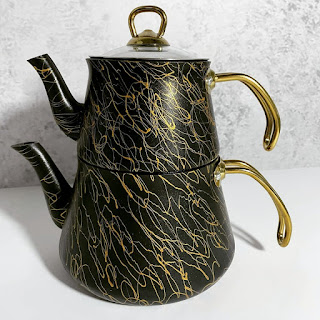
"In today‘s Kosovo Albanian language use we might often hear the word ‘gjygym’ which translates to teapot. The word was borrowed from Ottoman Turkish during the Ottoman reign over the Balkan Peninsula. In Ottoman Turkish the word was گوگم (güğüm) and it was already a loan from Ancient Greek κουκκούμιον (koukkoúmion)or κούκκουμα (koúkkouma).⁣

An antique "gjygym". For Hindi/Sanskrit speakers, you may know this as a "gagri".

⁣
The Ancient Greeks also took the word from Classical Syriac ܩܘܩܡܐ (qūqəmā) which meant pot in their language. However, this was also a loan from Imperial Aramaic ‫𐡒𐡅𐡒𐡌‬‎ (qwqm), which too, was borrowed from Akkadian 𒂁𒆪𒆪𒁍 (kukkubu, quqquba), referring to a smaller container used as an alabastron, libation jar, or drinking flask. ⁣
⁣
This word is in turn suspected to have been taken or developed from the Sumerian word 𒂁𒃻𒋫𒆸 (gugguru), which was a tall earthen vessel with a narrow opening."⁣

On calling out Calendars

Before there was the air raid siren of an Apple alarm tone, there were roosters to wake us up in the morning, by shouting, or “calling out” the break of dawn. As primates usually do, we copied this practice of calling out the time.⁣⁣You see, the Priests during the Roman times, used to “call out” or “declare” every new moon from the Roman Capitol. This was so the people could be made aware of the number of days till the “nones” (a Christian Feast), and was called the “calares” (derived from the PIE root “kale-”). ⁣⁣
⁣⁣
This was also relevant as these “calares” reminded people of the number of days left before they had to clear their debts and fill up the account book, called the “calendarium”.⁣⁣
⁣⁣
A page out of the Roman "Calendar" etched with days of religious importance.

These “calares”, gave rise to “calendars”. So, a calendar is literally something that is an “account book” (of number of days). Just to show they could make life more miserable for everyone, the Roman Catholic priests went ahead and invented pressing deadlines.⁣⁣
⁣⁣
Also, full moon reminds me, Beware of the Ides of March.⁣⁣

On why broken NY Resolutions can still be kept

A vast majority of the followers of Hinduism believe that taking a dip in the Holy River of Ganga can wash away all their sins. The piety touches its yearly acme in the month of “Magha”, marked by swarms of devotees from all across the world; all of humanity lining up for a 10-second dip in the water that can purge away their trespasses. ⁣⁣

Halfway across the world, perhaps synchronously (but one can only guess), another group of people made an almost similar divine discovery. Romans too had a dedicated ceremony for a “purification process”. This was a festival of honour, ritualistic purification and washing – called Februa (which literally means the “purification”). ⁣
⁣
This time of the year, therefore came to be called “February” in the Roman Calendar, and then in the Gregorian Calendar, coinciding with the month of "Magha" in the Hindu calendar.

The point of all this exposition, is that The Orientals and Occidents, all came together to give you a chance of washing away your mistakes and start the year anew. ⁣

"The Magh Mela at Allahabad", the Graphic, 1888.

So, if January was especially bad for you, it was only because it was meant to be. And history has got you covered. That’s why February exists – a time to purify.⁣
⁣
Refresh those resolutions you broke, restart that diet plan, and renew that gym membership, because etymologically, January of any year is just its probation period.⁣

On how to break NY Resolutions minus the guilt

The new year bought with itself old shenanigans – of covidiots, indifference, and a to-do list for the first week of January repurposed from the previous decade. ⁣⁣
“Resolution” is derived from Latin “resolvere” which means to “break into parts, or loosen”. Now, to solve a problem, it needs to be “broken down into parts” only then can it be finally “determined”. ⁣
⁣
This determination or “resolve” became what is traditionally taken to mean a “Resolution” in the 1780s. The Babylonians made promises to Gods to return debts at the beginning of the calendar year. So did the Romans, who made promises to the two-faced god of doorways, Janus. ⁣
⁣

A folio from Minnesänger's Codex. It depicts the "Vow of the Peacock", a medieval tradition wherein every New Year the knights restored their ideals of chivalry by swearing over a peacock feather.

All said and done, turn to Etymology when you skip that gym regimen on January 2nd, or have your second pizza of the day, three days after swearing off junk (like me). ⁣
⁣
Because as far as we are concerned, Resolutions are, literally, meant to be "broken".⁣
⁣
⁣

On Tactics and Tic-Tac-Toe

If we keep tugging at “-tag” (which still means “touch” in PIE), we reach Medieval Rome. Romans are famous for arranging two things – stabbings, and people to do those stabbings. They called the latter “tactics”. Or the science related to arrangement of military forces (well, technically it could be an arrangement of anything, but it is mostly used in the military context). ⁣

⁣
Could be said that they had a “tact” for such skirmishes (it means “touch”, so if you can handle anything well, you’re said to have the tact for that thing). Except while confronting that Gaul village perhaps, even little Dogmatix rendered them tactless.⁣
⁣
Now, if you were to touch things lightly, you would cause a peculiar sensation, a tactickle if you may, spelt as “tickle” for what I can only say are aesthetic reasons. That said though you can make a “lighter” version of anything by adding “-icle” at its end. A tiny piece of ice? An icicle. Small part in time? A chronicle. The smallest part? A particle. ⁣ ⁣

The Testudo, or the Tortoise, an intrinsic Roman military tactic which protected the legions against the incoming barrages from flanks and above, while allowing attacks from front. ⁣

Too bad that doesn’t work with our calendars. Nothing deserves an “-icle” more than this bloody year. And in the true spirit of 2020, let’s raise our glasses to disappointment, that even though it is one of the games that require exquisite planning, strategy, and even clairvoyance some would say, “tic-tac-toe” does NOT share its roots with “tactics”.⁣
⁣
It just refers to the tic and tac sound that is made when marking the Xs and Os. Cheers.⁣
⁣

Tuesday, 9 February 2021

On taxis and taxes.


Taxonomy is the science of classification within the science of life. It is derived from Greek roots “taxis” which means an “arrangement”, and “nomi-“ which is used to refer to a “method” (for example, the method of managing the “home”, or an “eco” as some might prefer, is called economy). “Taxis” has been carried about a lot in English. A set of things (usually rules) arranged “together”, become a syntax. And if that’s not heroic enough we have people who are into arranging skins. We call them taxidermists, and they are what made Jurassic Park, and Jaws possible.


“Taxis” is in turn derived from a Proto-Indo European root “tag” which means “touch”. That is where we get the game of Tag (which I found has variants including British bulldog, Poison, Octopus tag, Duck, Duck, Goose, and even a John Green version in Kiss Chase). “Touching”, in all senses, can leave a mark. It’s a burden, a strain, especially one made by the government. That, is called a “tax” – quite literally, a “burden”. This is also why we call carrying a heavy thing from one place to another, “taxiing”, and thusly, a “taxi”. 


Beatles' the Taxman, from the '66 album Revolver. George Harrison wrote the song as a protest against excessive taxes levied by the then UK government.
 

When that burden is in the form of a labour, it’s called a “task” (a spelling infliction of “tax” in Latin). So, technically a “taxing task” is redundant (and a redundant task is taxing).

Thursday, 4 February 2021

On the saurus and thesaurus


While a pterosaur is a “saur”, it’s not of the “dino” variety. There is such a thing as paleo-pedantry, and we make sure we own it.


“Dinosaur” comes from an Ancient Greek root “deinos-“, which means “terrible”, and “saur”, which means a lizard. One could argue that all lizards are terrible, but we’re sticking with objective complaints here. Like why is Bulbasaur a “saur”, but not Charmander? And why did a book of words ever come to be called a “thesaurus”? On the former, since I chose Squirtle (which is objectively the best), I do not care much about it. For the latter though – the answer is spellings.


You see, “treasure”, which is Latin for, well “treasure”, is spelt in Greek as “thesaurus”. And when a book came along which had a “hoard, or treasure” of words in it, it came to be called a “thesaurus”. It wasn’t like a usual dictionary, which demands you to look up an exact word. This was a treasure because here you stumbled upon a word – for an emotion, or noun, or a form of emotion or noun – which you did not know existed. Which I think is beautiful. In fact, you can call any treasure a “thesaur”, and any treasurer, a “thesaurer” if you so dare. 


Now, with no remorse for that digression, and keeping up with the Latin-Greek spelling tussle, the root “deinos-” in Latin is spelt as “dire”. Which means anything “dreadful” or “fear inducing”. This terminology was given by Sir Richard Owen. He was a palaentologist, who came across a fossil, and when asked what was the fossil of, he said “it seemed of a terrible lizard”. And as the case usually is, with people trying to sound smart in English by not speaking in English, he called it “dinosaur” (well, actually he coined “dinosauria”, an entirely new taxonomic group, but even I can see that that’s unnecessary information).


"Owen Riding His Hobby" by Frederick Waddy, drawn in 1873, during the peak of Owen-Darwin feud. Owen's reputation dwindled in his later years as he stood firm on his stance of "immutability of species", and refused to accept that species evolve.
 

And I guess that’s another reason to study etymology – to call out the gatekeepers.

Wednesday, 9 December 2020

The words of a Feather

 The Ancient Greek root of “fly or wings” is “pter-“. It is derived from the PIE “pet-“ which also means “to fly/related to wings”. ⁣
⁣
Before machines, the air was the path of huge lizards with wings for arms. These were pterodactyls (“dactyl” in Greek means “fingers”). Some also call them pterosaurs. but even before those lizards, it was the “old flying thing” that ruled the skies. No really, the Indys and Laras came across a really old fossil of a bird, and decided to call it “a really old bird”. Or “archaeopteryx”. ⁣
⁣

H. J Draper's Lament of Icarus, showing a dead Icarus after he flew too close to the Sun, surrounded by lamenting nymphs. ⁣
⁣Touted to be a parable of a university student finishing too close to the submission deadlines, surrounded by their lamenting grades. ⁣

With all due respect to Doyle and Spielberg though, do note that a pterosaur probably looked nothing like the two would have us believe. All pop-culture is based on the Rule of Cool, and anyone who says a T-Rex was not fat and fluffy (like a chicken perhaps?) does not know their herpetology (“herpet” is Greek for reptile), and palaeontology (“palaeon” in Greek means “old”). ⁣
⁣
The remaining others who are without wings are either called “apterous”, or sometimes (unironically), Icarus.⁣

On waltzing with Lord Helix

It was only too late that I realised the exit was pre-mature. “Wel-“, it turns out, has more words that it rolls out. Is it something to dance about? No. But we have “waltz” (a dance that involves lots of turns and whirls) anyway.


Lord Helix. Also called "the Lord and Savior", "the Almighty Helix" and "the Holy Helix". Known for spawning off the "Church of Helix" religion. ⁣

Now if you dance around with “wel-“ to Latin, it mutates to “hel-“. So, a “spiral-like thing” becomes a helix. That gives us words like helicity, helicometry, and helical (Yes, I too think that some of these words belong to the category of those which exist simply because they can). One of the more interesting ones though, is the word “helicopter”. It’s composed of roots “heli-“ + “-pter” (spiral + to fly). So, it literally is something that flies using a spiral action. That said though, “wel-“ has outlived its welcome. Raise a potion to Lord Helix, and let’s HM Fly off from here.⁣⁣


Thursday, 22 October 2020

Why revolutions need wallets


The realization of a struggle, is what we call a revolution. “Revolution” is made up of “re-“ which is Latin for “again”, and “volvere”, derived from PIE “wel-” which means to “turn”. So, it literally is a “turn of events”.


The most interesting root here is the PIE “wel-“. It forms a part of surprisingly many words. A act of bringing about a new turn of events is a revolt. It is successful though only when people become a part of this turn, or are “involved” in it. When successful, this “rolls out” a new chapter of society making it “evolve”. A revolt needs to be targeted though. Bringing together too many issues can result in it becoming “convoluted” (“con-“ in Latin means “together”). 


These revolts may not always end “wel-“ though. Often, they are curbed by an instrument, that turns a cylinder to reload, called a “revolver”. Other elements involved could be the substance found behind huge safes, which open by turning huge handles, called “vaults”. Those, which one keeps folded in “wallets”.


That is when one should turn to other things. For example, “wel-“ gives its name to a part of machine that folds or turns, called a valve, and a machine that works by turning (wheels perhaps?) called a Volvo. The curving, arched part of a building, and the jump you make rolling over that part shouting “PARKOUR!” are both called vaults, with the latter serving as a really cool exit too.

On the Agony of Antagonists


While we’re in the world of stages, let’s take a look at the players too. The first one is quite literally called the protagonist. “Protos” is the Greek root for “first”, or “principal”, accounting for words like prototype, protozoa, protean (the first son of Oceanus, who became the god of sea. He could change his form at will, and thus, the word), protein (the first discovered “quality”), protocol, etc.


The other root that forms “protagonist” is “agon-” which in Ancient Greek means “contest, or a struggle”. We can break up “agon-” further into a PIE root “ag-“, which is more aptly translated to “move, or to drive”. So the primary person who drives ahead a contest, or an event, like a drama, is a protagonist. Their side-kick is the deuteragonist, and the one who works against this idea of “moving it ahead” is the antagonist (I don’t think I can justify the irony here). 


Original Picture: Evan Augistini, Deadline


Whatever it is that needs to be “moved” is thus, the “agenda”, and the means through which it moves on, is the “agent” or an “agency”. If it gets confusing, as to where it is that one is actually “moving” the plot, like that of Rowling’s Cursed Child, it leads to “agitation”.


As we saw, this “agitation” only takes a slight push from PIE to Greek, to turn into a struggle, which may cause “agony”. It can get worse though, and result in antagonization, especially if you’re hell-bent on perpetrating hate speech. #transRightsMatter

Sunday, 4 October 2020

Theorizing about Theatre

 The word “theatre” is derived from Greek roots “thea-“, which means “to view”, and “-re” which is a prefix added much later by the British (the original Greek word was theatron). Thus, a theatre where you can look “all around” you, is called an amphitheatre (“amphi-“ means around, or “on both sides”). ⁣


Herdy Lamarr, a Hollywood actress touted "the world's most beautiful woman", who co-invented the "frequency-hopping spread spectrum". Her invention was instrumental in securing the air superiority by the Allies in the Second World War.

When you take a look at something, it is natural that you begin to create a mental image of it, relating it with one thing or another (as I’ve been trying, too hard apparently, with these posts). This process of taking a look, is called “theorizing”. And whatever you come up with then, is a theory – literally “an explanation borne out of looking at something”. When you’re able to make others see this theory as well, effectively proving it “for all to see”, it solidifies into a theorem. ⁣
⁣
Trust etymology to render the “STEM v. Arts” debate redundant.⁣
⁣

Sunday, 27 September 2020

What was comedic about the Divine Comedy?

As I have said before, one of the ways a stroll is fulfilling, is due to the people you meet along the way. I bumped across @aakriti_j8 , she curates some amazing content at @wordigraphy and is an etymology enthusiast like me. As conversations go, we got to talking about comedy and errors. No, not of the Victorian variety, but that of the being exiled out of Florence and ending up writing the most horrific account of hell and calling it a Comedy kind.
⁣
Dante’s Divine Comedy for starters, is a paragon of what AJ Cronin calls deceptive appearances. The only hilarious thing about his Inferno is how he created the entire thing out of pettiness and, for he was betrayed, decided that the most gruesome punishments (of being nibbled on by a three-headed Satan) was reserved for the poster-boy of treachery – Judas. This is what Aakriti on why it is called a “Comedy”. ⁣
⁣
“So, whosoever said “Tragedy + Time = Comedy”, was not that wrong. Both the words, “tragedy” and “comedy” are derived from the Greek word ‘ode’ meaning ‘song’ or ‘to sing’ (the same “ode” we see in “rhapsody” which literally means “wrapping, or weaving” a song). Other words it spawns are parody, melody and ⁣
⁣

Domenico di Michelino's Dante Illuminating Florence With His Poem.


At one point, the word ‘comedy’ even meant a poem’ in Old French. Somewhere around the late 14th century, comedy started to be defined as narrative with a happy ending. Since Dante started with Inferno and ended in Paradise, and had successfully threw shade at everyone who annoyed him, Aristotle, Socrates, Brutus, the works. It was a happy ending. Thus, Comedy. ⁣
⁣
The word “tragedy” on the other hand, is a story that ends unhappily. In literal terms, it means “a goat song” (from Greek “tragos”, meaning goat or buck). Said so because it’s traced to the song performed before rituals, where goats were sacrificed, or to competitions where the "singers competed for a goat as a prize". You’re free to choose what’s sadder.”

Friday, 18 September 2020

Of seeing Red and taming shrews

The colour Red means many things to many people. It signifies luck and fertility in the East. To the Westerners, it is entirely religious, associated with the nobles and the clergy. It was some bad luck of the Church, or just foreshadowing then, that the colour of the robes worn by its celibate elites (Cardinals) was one associated with carnal desires. ⁣
⁣
As with everything etymology though, that’s just the half of it. The actual symbolism that the Church wanted to signify from the Cardinal red, was that of Christ. You see, there was a light pink, flesh-coloured, ever-blooming flower called the “carnation”, named so because “kar-” in PIE literally means “cut”, like a piece of flesh, meat, or like the cut of the carnation flower, which gave it a peculiar shape. This shape resembled a crown, thus, we also got “coronation”. But I digress (yet, am not apologetic for it). ⁣
⁣
The piece of flesh, held great symbolism (His blood and His flesh). It is from here that the concept of incarnation (to be born in the flesh), gets its bearings. So, no wonder the Church wanted etymology on their side. ⁣

Portrait of a Cardinal by Raphael (who I'm sure would approve of using Instagram filters on his masterpieces).

⁣
It didn’t turn out too well though, obviously. Soon, the cardinal colour began to be associated more and more with the flesh, rather than “His flesh”. “Carnation” spawned off the word “carnal”. Which meant “human, or related to flesh”. So, a carnal need, was anything but. Someone who couldn’t control such desires, and fed on them, was “carnivorous”. A celebration of this entirely sinful activity which made a lot of people happy, was a “carnival”. The Church didn’t give up though. It continued to push its propaganda that this beautiful word they’d picked up was their own, and anyone who said otherwise would suffer from His “carnage” (a massacre involving cutting or slaughter of flesh). But even then, it didn’t work out. In fact, Carnage to people now, is a cheap red Venom-knockoff, and not some fury that Hell hath not seen. ⁣
⁣
Moral of the story, etymology is no one’s bi– shrew!  I meant shrew. Because you can’t tame it.⁣
⁣

Tuesday, 8 September 2020

If you want peace, prepare for war


Law of the jungle is that what’s beautiful, is dangerous. That wisdom did not come about by itself. From the PIE root “deu-“ sprung about “belle”, which in Latin means a “woman” and my third-favourite Disney princess. The same PIE root also gave rise to “bell-“ which means “war” or “warlike”.


Bellona on the badge given to the Volunteer Army during the First World War


The Romans, in what can only be an epiphany, decided that their deity of war is most definitely a woman, called Bellona. Bellona then went on to lend her name to all things war, including, to “Voldemort’s last, best servant” (Bellatrix Lestrange). Time is divided on the basis of wars, with ante-bellum (before), and post-bellum (after). The rules which governed the conditions which demanded a declaration of war in Rome were called “jus ad bellum” (“ad” means towards, so the rule in place while nations are nearing towards a war, to this day are called so). The code of law in place while the war went on was “jus in bello”. Those with an inclination towards fighting are termed “bellicose”, and those actually, belligerents. A beautiful irony, with the Red Cross picking up on the lingo of the deities of war.

Sunday, 6 September 2020

Drop-dead gorgeous


If you want to make an animated character look beautiful, you draw them with big, bulging eyes with dilating pupils. But it is a more Italian concept than Japanese. During the 1590s, the city of Florence had recently started promoting prostitution as a way of preventing sodomy (!). the Florentine women used a “trick of trade” to appear “wide-eyed beautiful”, more inviting to the Enlightened bachelors and infidels strutting about the streets. They used a kind of oil in their eyes, extracted from a flower, with the known property of diluting the pupils, and restricting your body’s nervous systems in general. Which means no sweating (so your make up stays on longer), no urination and salivation, and increased heart rate to help with “faking it” with the customers. 


Titian’s Woman with a Mirror, which shows a Woman applying belladonna to her eyes. The painting is now a famous commentary on vanity.


It didn’t take long for people to realise how deadly those side-effects could be. And soon, this oil became famous as the “fair lady poison”. As Italians were, they decided to name it so. And thus the flower was called Belladonna. From “bella-“ (beautiful) and “donna” (woman, as also seen in words like prima donna, and Madonna). Since then this deadly nightshade has found mentions by Shakespeare, macho Elizabeth who rarely took a bath, conniving ophthalmologists, and the Witches Three. Point is, “drop dead gorgeous” is foreshadowing, and the next time somebody tells you that, take the hint and go wash your face or something.  

Thursday, 20 August 2020

What makes you beautiful.

In PIE, the root “deu-“ means “good” or “to revere”. It gives rise to the root “beu-“, “ben-“ and “bon-” in Latin which, unsurprisingly, spawn all sorts of words related to beauty and money. It is obvious now where “beauty” (literally) comes from, but what’s not obvious is that is the effemination of the word “beau” (or “beaut” for a more inclusive understanding) which refers to the suitor of the lady, all of whom are wishing for a “boon” (a prayer, usually for something good). This boon can be in form of a bonus, or even a bounty, and result in a bonanza. For a child though, just a bonbon (a type of confectionary) would suffice. 


But the benefit of boons is only granted to the most Benedictine (one who speaks good, closely associated with God, or Pope), to the most benign (kind, generous, just a good person) and benevolent.

To balance off the diabetic nature of the write-up I’ll just throw in that the other set of roots that spout off “deu-“ mean war, poison, destruction and death.

Thursday, 6 August 2020

Just say it wasn't you

The “dictionary” is made of the principal root “dict-“. In Latin, “dict”-“ or “dicere-“ means “to speak (for)” or “to show”.⁣
 ⁣
Somebody speaking then can be called to be giving “dictation”, and would themself be the “dictator”. On those lines, the place where your word is law, is said to be under your jurisdiction. Every statement you say is a “dictum”, and your decision the “verdict” (if you’re feeling fancy you can also call it “voir doir” or French for “true word”). On the other hand, if you are drawn towards someone’s (or something’s) bidding, almost as if swayed by their (or its) words, then you’re an “addict” (“ad” means towards in Latin), and we have a problem.⁣


 ⁣
When your friend comes to you with a problem, after doing something stupid which you clearly told them not to do, they’re said to be in a “predicament” because you “predicted” it. Now it’s up to you (again) to “vindicate” (to show on their behalf or simply, avenge) them. Then, when you have successfully made the situation worse, you can call upon the spirit of Benwfeuvbw Ciumriaebjjfhh to sweet-talk (“bene” means “good”) your friend into showing how it was their fault all along and hopefully they’ve learnt something from this entire episode.